Guess How Many in the Jar Printable: Free Signs, Guess Cards and Guest Sheet
Fill a jar, count what goes in, and let guests write down a number. The closest guess wins the jar. The free PDF comes in two versions, one for a baby shower and one for a bridal shower. Each has a table sign with the rules, guess cards four to a page, and a guest sheet if you’d rather skip the cards. The bridal version adds a “Kisses for the soon-to-be Mrs.” sign. You can download either one directly without giving an email.
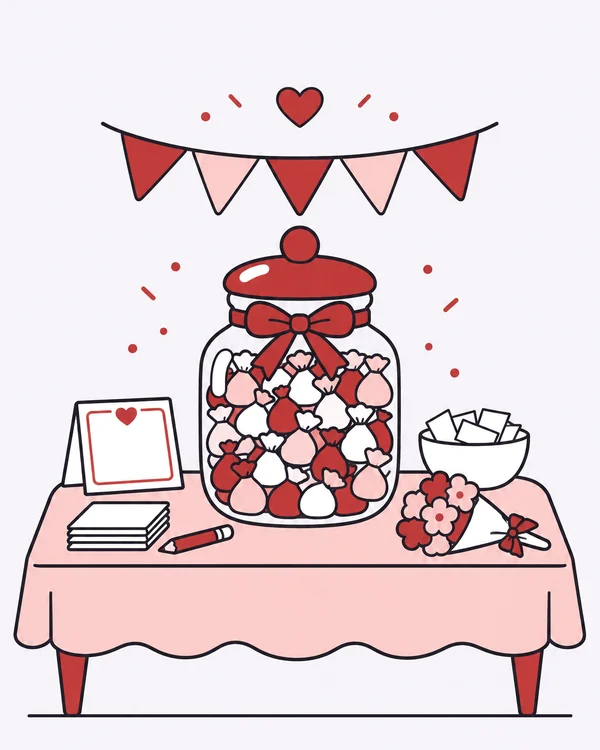
What’s in the free PDF
Pick the baby shower version (rattle, bottle and onesie drawings) or the bridal shower version (flowers, rings and cake). Both have:
- “How Many Are in the Jar?” sign. The rules are printed on it, so guests can play without asking you.
- Guess cards, four per page. Each card has a line for the name and one for the guess. Guests fold them and drop them in a bowl.
- Guest sheet. One page with 20 lines for name and guess. Leave it next to the jar with a pen and you have nothing to cut.
The bridal version adds a “How Many Kisses for the Soon-to-Be Mrs.?” sign, for a jar of chocolate kisses.
Everything prints on plain US Letter paper and still reads in black and white. Print as many card pages or guest sheets as your guest list needs.
How to play, in 5 steps
- Check with the guest of honor. Games at a shower are optional. The Emily Post Institute’s advice is to “check with the parent(s) to be that these games would be welcome”, and the same courtesy works for a bride. A jar game is usually an easy yes, since nobody has to perform.
- Fill the jar and count as you go. Write the final number on a piece of tape under the lid, or on the back of the sign, before the party. More on counting below.
- Set up the jar, the sign and the cards. Put them where everyone passes: by the entrance or the gift table. Leave two pens.
- Close the guessing at a set time. Collect the cards (or the guest sheet) before gifts or before cake, so you have a few minutes to check them.
- Announce the winner. Read the real number, then the closest guess. The winner takes the jar home.
How to count the jar without losing track
Do the counting before the party. One simple way to do it:
- Count the candy into small cups or zip bags, ten at a time.
- Pour each cup into the jar and make a tally mark for every ten.
- Count the last few pieces one by one and add them.
- Write the total on tape under the lid and take a photo of it, in case the tape goes missing.
If two people fill the jar together, have one count and the other pour, so it’s harder to lose your place.
Decide the tie rule before anyone guesses
Two guests can land on the same number, or the same distance from the answer. Pick the rule first and say it out loud, or write it under the rules on the sign. Some options:
- Closest guess wins, over or under. The simplest rule. If 112 is the answer, 110 and 114 tie.
- Closest without going over. Fewer ties, because a guess above the answer can’t win. Tell guests up front, since it changes how they guess.
- First to write it wins. With the guest sheet, the order of the lines shows who guessed first. With cards you can’t tell, so use another rule.
- Split the prize. Divide the jar between the two winners. Easy when the jar is candy.
- A quick second guess. Hold up a small cup of the same candy and ask the tied guests how many are in it. Closest wins.
What to put in the jar for your shower theme
Pick something small, all the same size, and easy to give away afterward. Wrapped pieces are easier to share if the winner wants to pass them around.
- Bridal shower: chocolate kisses for the “soon-to-be Mrs.” sign, candy hearts, or white and silver wrapped chocolates.
- Baby shower: jelly beans or candy-coated chocolates in the shower colors, or mini candy bars.
- Bee theme (“what will baby bee”): wrapped honey candies, or any yellow and black wrapped candy. Call it a “guess how many honeycombs” jar if that matches your invitations.
- Fall shower: candy corn, or mixed candy in orange and brown wrappers.
- No candy: cotton balls, pom-poms, or mini clothespins. In one r/BabyBumps thread, a mom helping plan her daughter’s shower said the candy her daughter was craving cost too much to fill a jar, and that baby socks would mean more socks than a newborn needs. A cheap filler plus a small separate prize solves both problems.
A smaller jar makes the game quicker to judge, and guesses land closer together. A huge jar makes for wild guesses, which can be part of the fun.
How guests can make a better guess
If a guest asks for a strategy, you can pass on these two tips.
Count one layer, then the layers. Count the pieces across the bottom of the jar, count how many layers stack up to the top, and multiply. It won’t be exact, because pieces settle unevenly, but it beats a wild guess.
Remember the air. Candy doesn’t fill a jar solid. Physics World, reporting a 2004 study in Science by Paul Chaikin and colleagues at Princeton and Cornell, says randomly packed spheres “fill a maximum of only 64% of the total available space”, while candy shaped like M&M’s can pack to “between 68 to 71%.” For round or lentil-shaped candy, roughly a third of the jar is empty space.
A fun reveal: the crowd’s average
Before you read the real number, add up all the guesses and divide by the number of guests. Read that average out loud first.
An average like this can come surprisingly close to the real answer. In 1907 Francis Galton wrote in Nature about a weight-judging contest at the West of England Fat Stock Show in Plymouth, where visitors guessed the weight of an ox and 787 cards could be read. When economist Kenneth Wallis rechecked the data in 2014, he found a few transcription errors in the published numbers. With those fixed, the ox weighed 1,197 lb and the mean of the guesses was 1,197 lb too, “the mean forecast here exactly coinciding with the outcome”.
A shower crowd is much smaller, so the average can miss by a lot. It still makes a fun step before the real number: “Together you guessed 140. The real number is…”
Prize ideas
The jar itself is the classic prize: the winner takes the whole thing home. If the jar is filled with something that isn’t edible, or you want a second prize, the Emily Post Institute suggests a host “have a few prizes on hand for the game winners” and names a box of chocolates or hand lotions and soaps as ideas.
When this game fits
A jar game runs in the background while people talk and eat, so it suits a shower where the guest of honor doesn’t want organized games. In one r/beyondthebump thread, a user hosting for a friend who didn’t want any organized games listed guessing how many candies are in a jar among the ideas so far for games that run on their own.
It also works for a mixed crowd, because nobody has to know the couple or the mom-to-be well to play.
Printing tips
- Print on US Letter at “Actual size” or 100%.
- Print the signs on light cardstock if you have it, and stand them in a frame or on a small easel.
- Cut each card page in half both ways to get four cards.
- For a big shower, print the guest sheet twice and keep both by the jar.
FAQ
How many candies should I put in the jar?
There’s no right number. Use what fits your jar and your budget, and count it carefully. A smaller count is quicker to check at the end.
Cards or the guest sheet?
Cards keep guesses private, so nobody copies the guess before theirs. The sheet is faster to set up and shows who guessed first, which helps with ties.
Can kids play?
Yes. Give them their own cards, and decide before the party whether they compete for the same prize.
Does it work for a co-ed shower or a sprinkle?
Yes. The main sign doesn’t say baby or bridal, and the rules are the same.
What if nobody is close?
The closest guess still wins, however far off it is.
Hershey’s Kisses is a trademark of The Hershey Company, and M&M’s is a trademark of Mars, Incorporated. Shower Playbook is not affiliated with either company.
Sources
- The Emily Post Institute, “Party Game Ideas for Baby Showers”: https://emilypost.com/advice/party-game-ideas-for-baby-showers
- Francis Galton, “Vox Populi,” Nature 75 (1907), 450–451; summarized in Karl Pearson, The Life, Letters and Labours of Francis Galton, vol. 2 (galton.org): https://galton.org/cgi-bin/searchImages/search/pearson/vol2/pages/vol2_0468.htm
- Kenneth F. Wallis, “Revisiting Francis Galton’s Forecasting Competition,” Statistical Science 29(3), 2014: https://arxiv.org/abs/1410.3989
- Physics World, “Packing them in” (on Donev et al., Science 303, 990, 2004): https://physicsworld.com/a/packing-them-in/
- Donev, A. et al., “Improving the Density of Jammed Disordered Packings Using Ellipsoids,” Science 303 (2004), 990–993: https://collaborate.princeton.edu/en/publications/improving-the-density-of-jammed-disordered-packings-using-ellipso/
- Reddit, r/BabyBumps, “What to put in the guessing jar at the baby shower?” (user story): https://www.reddit.com/r/BabyBumps/comments/1dyqzyz/what_to_put_in_the_guessing_jar_at_the_baby_shower/
- Reddit, r/beyondthebump, “Passive baby shower games? Prizes?” (user story): https://www.reddit.com/r/beyondthebump/comments/1ci3kwh/passive_baby_shower_games_prizes/